You searched for: adhd/feed/www.coh-fit.com
Search results
-

What are the barriers to mindfulness for Tourette’s?
We know that mindfulness and meditation can be of great benefit to people but it is a challenge for those with movement disorders such as Tourette Syndrome.
Read more -

In Conversation… Professor Tamsin Ford
Tamsin Ford is a Professor of Child and Adolescent Psychiatry at the University of Exeter Medical School. While Tamsin set out on her career path aiming to become an old age psychiatrist working as a clinician, she ended up as a child psychiatrist working in research. Discover more about Tamsin’s career and her research group assessing the effectiveness of services and interventions which aim to support the mental health and wellbeing of children and young people.
Read more -

Language stability in primary school-aged children hinders catch up for those with language disorders
In 2017, the Journal of Clinical Psychology and Psychiatry published the latest results of the Surrey Communication and Language in Education Study (SCALES), in which Courtenay Frazier Norbury and colleagues investigated language growth and stability in a population cohort of children with varying degrees of verbal and nonverbal cognitive abilities and a wide range of additional diagnoses.
Read more -

What is an intellectual disability?
This alphabetical framework is designed as an aide memoire for the identification of an ID (in children, young people or adults). It will help you identify available information sources and gaps in knowledge about an individual’s ability. It will guide you in decision making regarding a likely diagnosis and help you generate a needs based plan.
Read more -

DLD – Developmental Language Disorder
Developmental language disorder (DLD) is diagnosed when a child’s language skills are persistently below the level expected for the child’s age. In DLD, language deficits occur in the absence of a known biomedical condition, such as autism spectrum disorder or Down syndrome, and interfere with the child’s ability to communicate effectively with other people.
Read more -

Adoption and attachment: A parent’s perspective
Guest blog from Dr Taylor: “I am grateful for the opportunity to recount my experience of inviting a traumatised child into my family. If I can persuade those working in children’s services to change this experience, even for just one family, I will have achieved something worthwhile.”
Read more -

Diagnostic framework for attachment disorders needs improving
Reactive and Disinhibited Attachment Disorders (RAD and DAD) occur when infants and young children have not been able to form an attachment to their primary caregiver, but questions have been raised as to whether these disorders are being over-diagnosed in adopted children.
Read more -

Tourette Syndrome
Tourette Syndrome (TS) is a neurological condition that is estimated to effect over 300,000 children and adults in the UK; and one school child in every hundred.
Read more -
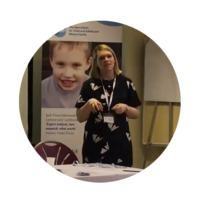
‘The costs of Conduct Disorder and evidence for parenting interventions’ Madeline Marczak
Madeline Marczak on ‘The costs of Conduct Disorder and evidence for parenting interventions’. Recorded on 19 April 2019 at the North West ACAMH Branch as part of a conference on Conduct Disorder. ACAMH members can now receive a CPD certificate for watching this recorded lecture.
Read more -

‘Building psychologically informed Forensic CAMHS’ Dr James Millington
Dr. James Millington on ‘Building psychologically informed Forensic CAMHS’
Recorded on 19 April 2019 at the North West ACAMH Branch as part a conference on Conduct Disorder.
ACAMH members can now receive a CPD certificate for watching this recorded lecture.
Read more