Social Anxiety Disorder (SAD)
-

Meet the expert: Practical techniques for managing social anxiety in everyday clinical work, with Dr. Eleanor Leigh
We caught up with Dr. Eleanor Leigh, Associate Professor and MRC Clinician Scientist Fellow at the University of Oxford, to talk about practical techniques for managing social anxiety in everyday clinical work.
Read more -

Social Fears in Children: The Roles of Parental Communication and Child Temperament
A recent longitudinal study by Zeytinoglu and colleagues (2025) provides insights into how parental verbal communication and child characteristics contribute to the transmission of social fears. The study shows the impact of both positive and negative maternal statements about ambiguous social situations, finding that positive comments were linked to reductions in children’s social fear beliefs, while negative comments predicted increases, especially among children who were behaviourally inhibited or had high anxiety.
Read more -

Professor Lina Gega
Lina Gega is Professor of Mental Health at the University of York and Honorary Nurse Consultant at Tees, Esk & Wear Valleys NHS Trust, with a PhD in Health Services Research from the Institute of Psychiatry, King’s College London. She is a Joint Editor of CAMH.
Read more -
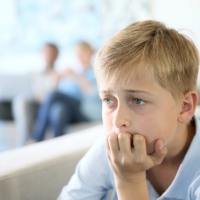
EEG data might help identify children at risk for social anxiety
Electroencephalography (EEG) is a non-invasive method to monitor the electrical activity of the brain. There are five main broad frequency bands in the EEG power spectrum: alpha, beta, gamma, delta and theta. Data suggest that EEG-derived delta–beta coupling — indicating related activity in the delta and beta frequency bands — might serve as a marker of emotion regulation.
Read more -
Do children with social anxiety disorder benefit from social skills training?
Social anxiety disorder (SAD) in children can be difficult to treat, as evidenced by the varied outcomes reported post-treatment.1,2 Although childhood treatments for SAD commonly involve at least some social skills training,3 it isn’t clear whether children with SAD have particular difficulties with social skills. There is therefore a need to better establish whether social skills are an effective target for treating SAD.
Read more -
Adult ABMT protocols need adapting for effective use in children
Attention bias modification treatment (ABMT) aims to target attention biases in threat processing in patients with anxiety1. While ABMT seems to be effective in adults with social anxiety disorder (SAD),2,3 its effect in youths with SAD and the potential treatment moderators are unclear. In 2016, Lee Pergamin-Hight and colleagues conducted a randomised controlled trial to explore the efficacy of ABMT in youths and the influence of possible moderators of treatment outcomes.
Read more -
Children with a Specific Phobia do better in Individual CBT than Group CBT and guided parent-led CBT
Children often present to health care settings with highly impairing and disabling anxiety disorders, including Specific Phobia, Social Anxiety Disorder, Generalised Anxiety Disorder and Separation Anxiety Disorder.
Read more -
Negative interpretation bias in adolescents with subclinical social anxiety disorder
Social Anxiety Disorder (SAD) is a marked fear or anxiety of social situations where an individual may be exposed to possible scrutiny by others. Now, Yura Loscalzo and colleagues have examined the contribution of different components of interpretation bias — a model proposed to explain SAD whereby affected individuals systematically assign a threatening meaning to an objectively ambiguous stimulus with several possible interpretations.
Read more