You searched for: autism+series+guide/feed/www.clinical-partners.co.uk.
Search results
-

Reflections of an International Elective Trainee in Child and Adolescent Psychiatry: what can we all learn from each other?
International Elective rotations (IER) are a widely practised phenomenon globally and can offer cross-cultural insight to mental health professionals.
Read more -

Global development and injecting drug use in a new generation of adolescents
People who inject drugs tend to begin doing so in adolescence, and countries that have larger numbers of adolescents who inject drugs may be at risk of emerging epidemics of blood borne viruses unless they take urgent action.
Read more -

Can ‘FRIENDS’ in school help prevent anxiety?
Researchers in Norway have assessed whether the FRIENDS programme is best used as a prevention measure or as a treatment approach for anxiety in school-aged children.
Read more -

Child mental health professionals need more technology training
Bethany Cliffe and colleagues have surveyed 154 CAMHS professionals to understand why technology-based tools have not yet been widely adopted by CAMHS.
Read more -

Is parental educational status to blame for academic problems in children?
Children of parents with low educational attainment have up to three-fold higher risk of developing a psychiatric disorder such as attention deficit/hyperactivity disorder (ADHD) and depression than children of parents with high educational attainment.
Read more -

How can a robot help your mental health? Meet ‘Zobot’ and see
Cath Kitchen, Head Teacher and Project Manager for the DoE AV1 project, and Zoe Johnson ‘Zobot’ explain how this innovative device is helping young people with long term physical and mental health issues to ‘virtually’ attend school.
Read more -

Developmental Language Disorder in Children and Young People
Developmental language disorder (DLD) is diagnosed when a child’s language skills are persistently below the level expected for the child’s age. In DLD, language deficits occur in the absence of a known biomedical condition, such as autism spectrum disorder or Down syndrome, and interfere with the child’s ability to communicate effectively with other people. Expressive language is characterised by non-specific words and short simple sentences to express meanings beyond the age at which children may be using more complex language.
Read more -
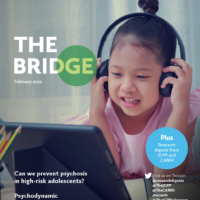
February 2021
This issue of The Bridge includes several articles which focus on child and adolescent psychoanalytic psychotherapy. This therapy aims to help young people, their families, or their support networks to better understand each young person’s emotions, behaviour, and relationships.
Read more -

Adolescent mental health resilience after childhood adversity
This event has been postponed. Please see the above message.
- Event type
- Special Interest Group
- Location
- Dublin
-