
At Marlborough House, an adolescent unit in Swindon, we have been working with nature to improve young people’s wellbeing. Nature-based approaches are increasingly recognised as valuable within CAMHS, including inpatient settings, and Marlborough House has contributed to this growing evidence.1
Alongside this, we have been asking ourselves, ‘How does an inpatient CAMHS unit compare to our own perception of a healing environment?’
As busy CAMHS professionals, we know that recovery from emotional strain depends on connection, rest, movement and time outdoors. Yet many of these essentials are limited within inpatient care. This raises the question – if the environment itself does not support wellbeing, how can it fully support recovery?
In this blog, we reflect on our work at Marlborough House and explore the growing role of nature and mental health within inpatient care.
How nature improves mental health within inpatient care
Since the pandemic, there has been an increase in the complexity of young people referred for inpatient care, and particularly of those with a diagnosis of autism. There has been a lot of work on how we can adjust our environments, particularly for these neurodiverse young people.
The benefits of nature for mental health are clear, and going outside reduces many of the challenges of the sensory environment.2 The intensity of bright lights, noise and confinement is reduced, often resulting in a calming and regulatory effect.
Often, there is concern about the risks of enabling unwell young people to access outside space. But conversely, a restrictive, bright, noisy environment can lead to escalation rather than enabling emotional regulation.3
How nature improves mental health may not always be evident. But working outdoors, in connection with the living world, inherently promotes a holistic and (eco)systemic approach. This offers young people novel ways to step outside of problem-focused narratives and into new ways of relating to themselves, others and the living world that surrounds them.4
Barriers to accessing the benefits of nature for mental health
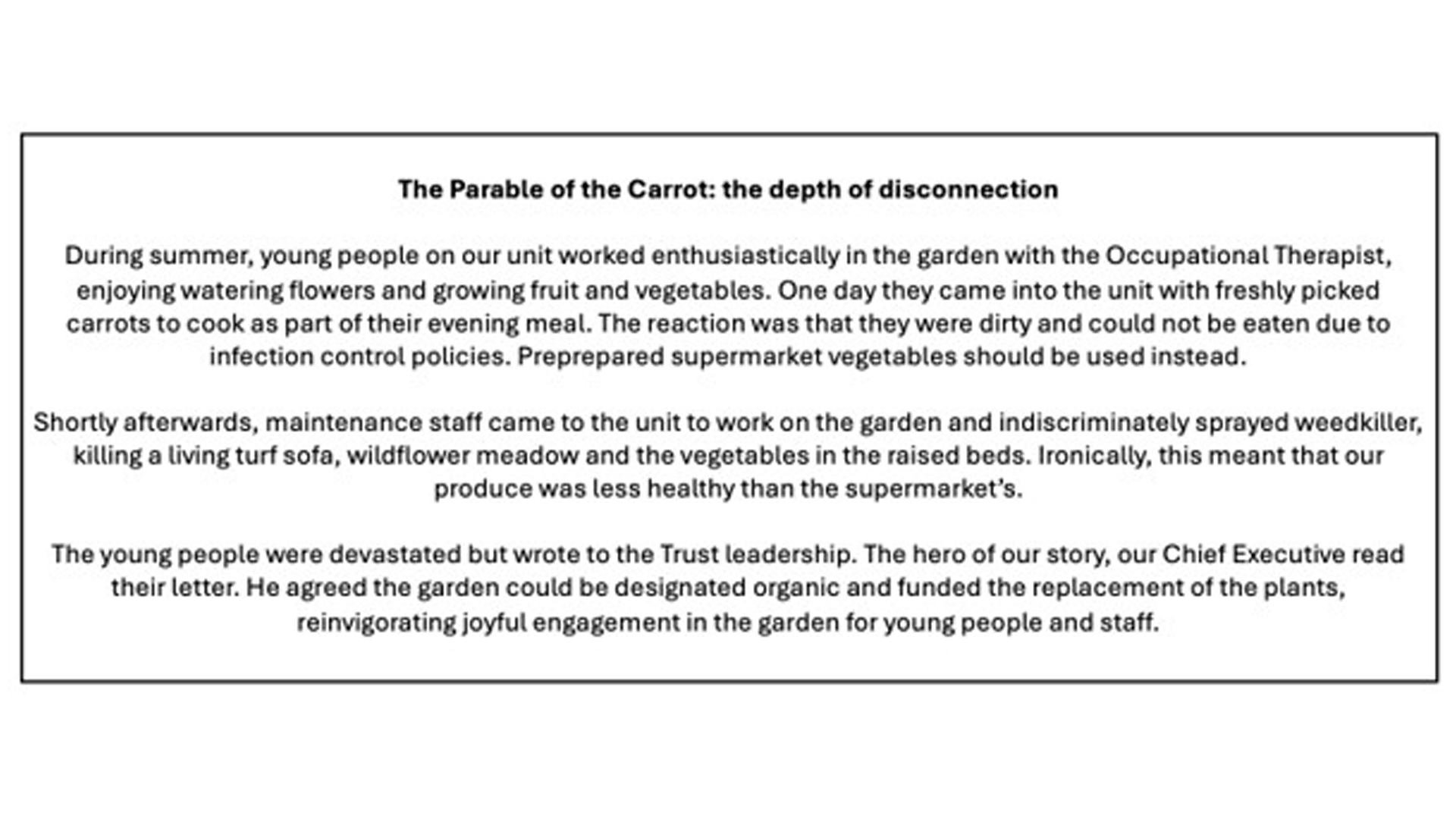
It is easy to assume that everyone on the team understands the importance of nature and mental health interventions, but this has been one of the challenges in building shared commitment within the team.
A key difficulty has been convincing some staff of the value of the ordinary activities we aim to embed into the ward routine to create positive experiences and support emotional regulation. Daily walks, which young people value highly, are frequently withdrawn due to rain or cold weather. When risk increases on the unit, access to the garden is often restricted rather than protected. Trips to local parks or the countryside are cancelled due to short staffing, rather than being prioritised for their role in de-escalating maladaptive behaviour.5
 Nature-based approaches to mental health care
When it comes to nature mental health interventions within inpatient care, there are many options. We assessed the following:
1. Family activities in nature
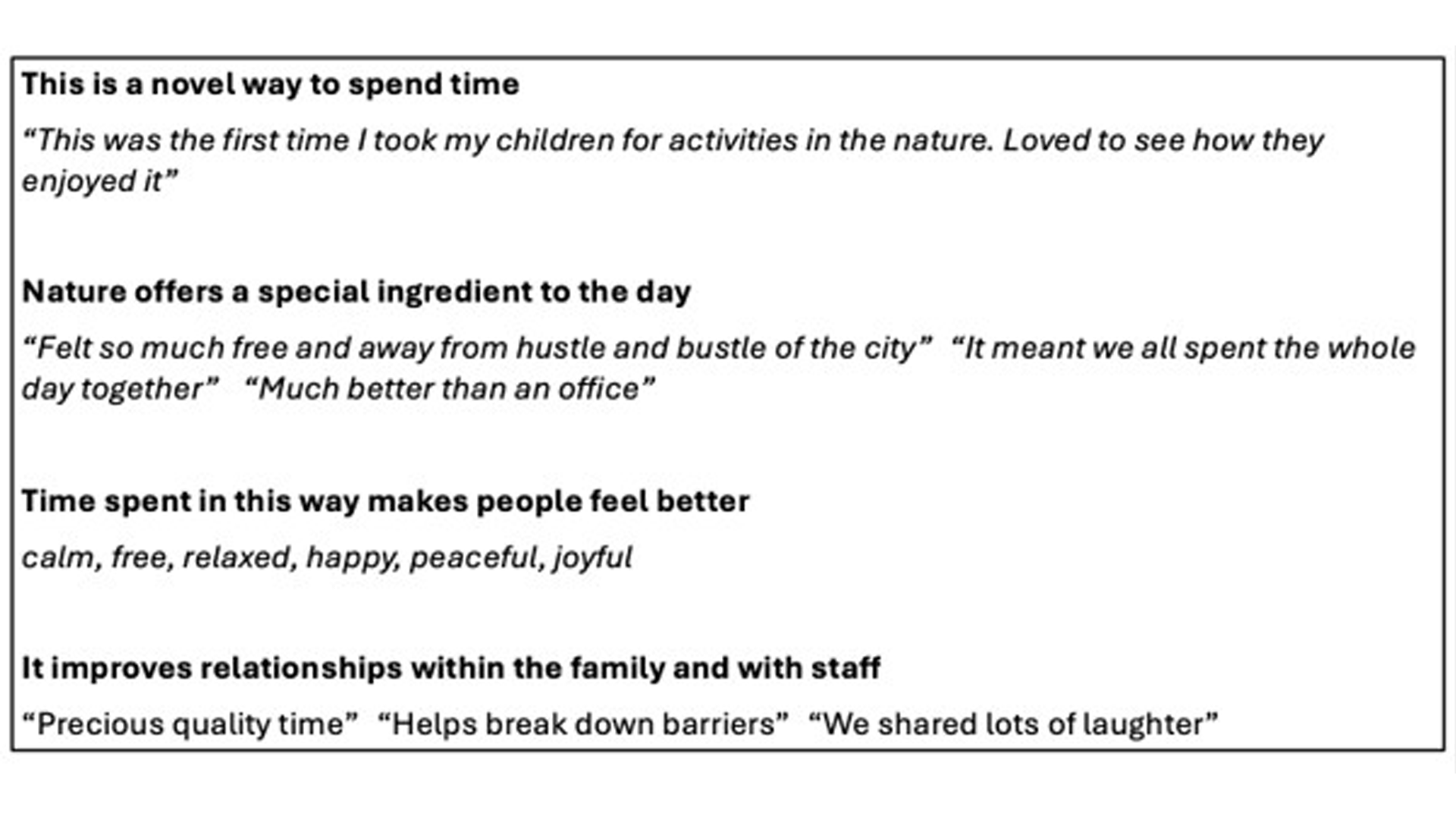
Building on the work of the Riverside Unit in Bristol, which developed the Families in the Wild model, we partnered with Wiltshire Wildlife Trust (WWT) to run a family-based intervention in the beautiful surroundings of Lower Moor Farm. Families attend for 2 days. Each family is supported by two staff members – one from Marlborough House, and another from WWT – who facilitate enjoyable bushcraft activities.
The nature of the setting and activities enable families and staff to have deeper conversations that can unlock insights and solutions. The feedback from families is moving and powerful, and has similar themes each year.
2. Caring for nature and mental health
Families in Nature inspired us to find further opportunities to work in partnership with nature organisations. These partnerships offer three key advantages:
- Bring together complementary skills and perspectives,
- Introduce us to local land and wildlife,
- Enhance the range and quality of interventions available.
These practices enable us – young people and staff – to contribute towards caring for nature as well as benefiting from it.
3. Connecting with nature
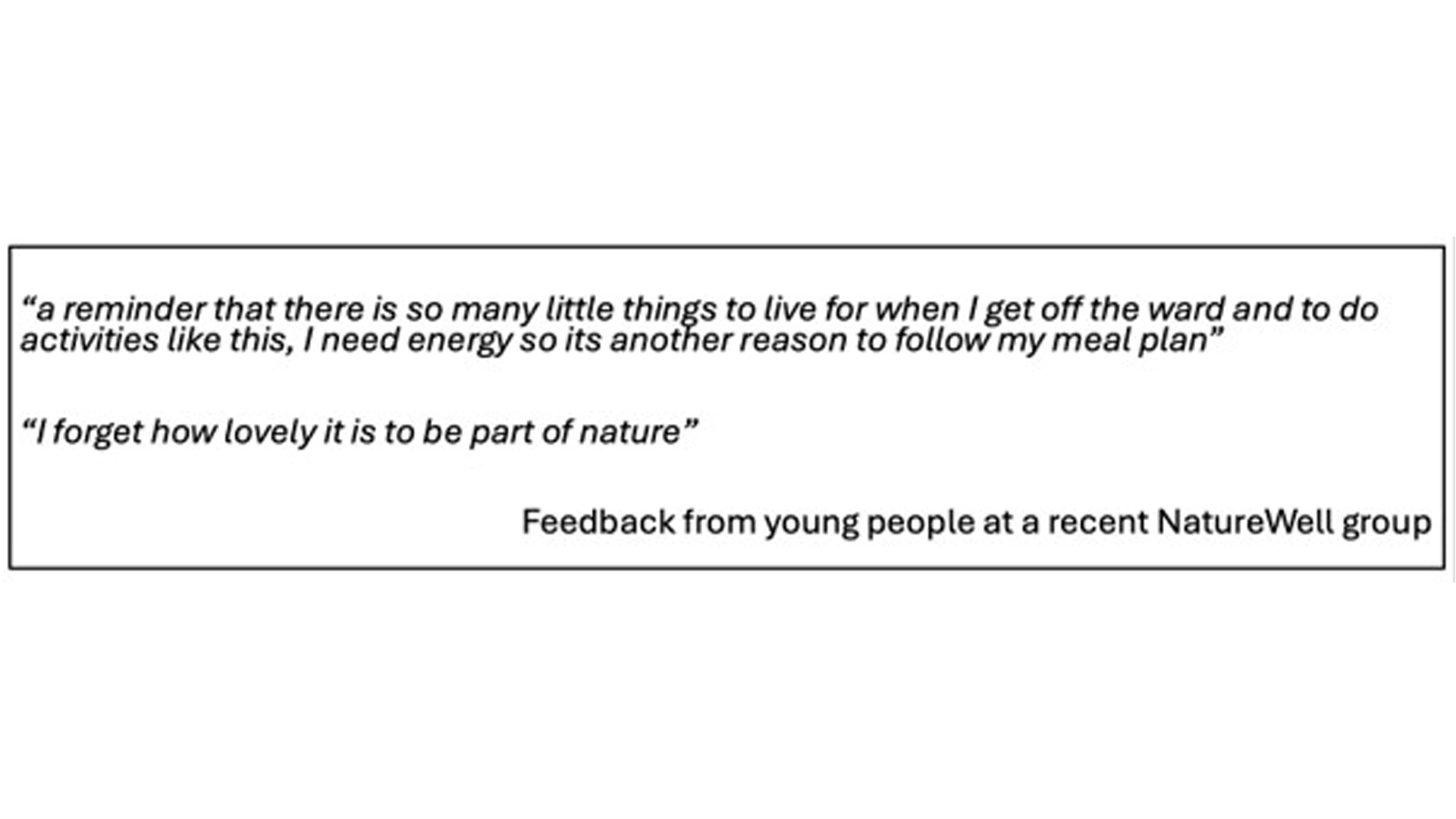
These weekly sessions bring nature connection onto the unit. This is a 6-week rolling programme of group sessions, co-created with medical students from the University of Bristol alongside young people on the unit.
The content is based on Natural Academy’s NatureWell approach and Derby University’s 5 pathways to nature connectedness. These sessions include creative, fun, nature-based activities, tailored to the needs of the group, outside whenever possible.
The aim of these sessions is to help young people build the skill of nature connection to support their mental wellbeing.
Rethinking how we approach nature in inpatient care
Bringing nature into an inpatient CAMHS setting is challenging. Concerns about risk, staffing pressures and entrenched routines often push time outdoors to the margins, especially when acuity is high.
Risk aversion and the resulting restrictions reduce quality of life and a sense of ‘a life worth living’, which in turn can lead to an escalation in risk behaviours. However, front loading care with opportunities for activity and responsibility, such as those we have described here, can paradoxically reduce risk, whilst fostering autonomy and resilience.
We believe inpatient services need to be bold in re-imagining what healing environments look like. There is a simplicity involved in valuing the ordinary: daily walks, outdoor spaces, meaningful activity, seasonal change. It also requires working in partnership, listening closely to young people, and being willing to challenge systems that unintentionally reinforce disconnection.
Final thoughts on nature mental health approaches
Our experience – echoed by young people and families – shows that time outdoors and nature connection is not an optional extra, but a core ingredient of a therapeutic environment.
As the complexity of young people’s mental health needs grows alongside climate and social instability, services need interventions that are effective as well as future-facing. Nature-based approaches do both. They support regulation, recovery and wellbeing while restoring connection, meaning and hope.
We believe that nature connection plays a vital role in the future of inpatient CAMHS. We warmly welcome dialogue with other clinicians and services who share this hope, and encourage teams to reflect on how nature might be more consistently embedded into everyday care.
To everyone working in this environment: Ask yourself everyday – what opportunities are there to enable young people to experience nature connection – indoors or out. Even the briefest moment can be impactful.
References
- Hunt, D. F., Morshead, G. R., Hayes, R., Mitchell, S., Chapman, B., Dutton, C., Adlam, A., & Mellor, C. (2025). Innovations in Practice: Beyond the clinic – embracing natural environments in mental health care for children and young people. Child and Adolescent Mental Health, 30(4), 422–429. https://doi.org/10.1111/camh.12768
- Li, D., Larsen, L., Yang, Y., Wang, L., Zhai, Y., & Sullivan, W. C. (2019). Exposure to nature for children with autism spectrum disorder: Benefits, caveats, and barriers. Health & Place, 55, 102–110. https://doi.org/10.1016/j.healthplace.2018.11.005
- Norouzi, N., Martinez, A., & Rico, Z. (2023). Architectural design qualities of an adolescent psychiatric hospital to benefit patients and staff. Health Environments Research & Design Journal, 16(4). https://doi.org/10.1177/19375867231180907
- Hinse, M., Joschko, L., Pálsdóttir, A. M., & Grahn, P. (2023). Nature-based therapy in individuals with mental health disorders, with a focus on mental well-being and connectedness to nature—A pilot study. International Journal of Environmental Research and Public Health, 20(3), 2167. https://doi.org/10.3390/ijerph20032167
- Liu, K., Saito, E., & Linder, H. (2025). Healing spaces: A retrospective cohort study on the effect of outdoor spaces in psychiatric inpatient units on PRN medication use, seclusion/restraints, and constant observation. Frontiers in Psychiatry, 16, 1731925. https://doi.org/10.3389/fpsyt.2025.1731925