
I am writing this article as a mental health practitioner and researcher, but it was a personal experience that led me to develop research in this area.
Sometime in June this year, the smell of smoke woke me in the middle of the night. No mean feat, as I “sleep like the dead”, so I’ve been told. In my tired, slightly surreal state, my first thought was that perhaps my daughter had left a candle burning. I burst through her door. No candle. Had I left something on downstairs? No.
By now, the dog was barking at the back door, perhaps assuming that my midnight dashing around meant we were about to be invaded by squirrels. I opened the door to let her investigate and was hit by a wall of smoke. It was so strong, heavy and close that I assumed a neighbour’s house must be on fire. Around me, lights were coming on as neighbours opened doors and windows, trying to make sense of what was happening.
I checked the news and discovered there was a wildfire, but nearly 25 miles away. I remember thinking: if the smoke is this strong here, what must this feel like for the thousands of families living much closer?
Over the following weeks, climate-related disruption suddenly became much more real to us. Local schools closed on some days because of the heat. Smoke remained visible in the air. I pleaded with my sporty son not to go running, frantically Googled how hot was too hot for a small furry dog at night, and started thinking about how quickly extreme weather could reach into so many ordinary parts of family life.
That experience changed the questions I was asking as a clinical psychologist. What happens when extreme weather begins to disrupt the ordinary things that help children feel safe and well: school, routines, relationships, sleep, activities and access to support? And, given my research into trauma-responsive care in children’s services, I began to wonder whether trauma-responsive principles could help us think about how we prepare for, respond to and recover from climate-related disruptions.
Summary
According to the Children’s Climate Risk Index (CCRI), almost half of children worldwide are living in countries highly exposed to climate and environmental risks (UNICEF, 2021) and emerging research is indicating children are physiologically more vulnerable than adults to some climate-related hazards (Ahdoot, et al., 2024). Climate-related disruption can affect the places, routines, relationships and services that help children and young people feel safe and supported. This blog explores whether a trauma-responsive approach could help us prepare for and respond to these disruptions, while recognising that we probably have more questions than answers at this stage in this process.
What is the problem?
Climate-related disruption can include the effects of extreme heat, flooding, storms, wildfires and poor air quality on children’s homes, schools, transport, routines, relationships and access to support. For children’s mental health, the environmental event may therefore be only part of the story. What also matters is what gets disrupted around a child, how long disruption lasts, and what resources families, schools and communities have to respond and recover. It has been posited that understanding, monitoring and reducing risks related to climate-related disruption is both a matter of social justice and an important long-term investment in children’s development and mental health (Vergunst & Berry, 2022). This is where trauma-responsive thinking may have something to offer. Rather than focusing on children’s ability to cope, it asks how families, schools, services and communities can maintain safety, trusted relationships, predictability and agency before, during and after disruption.
These impacts may be particularly significant for children already experiencing adversity or inequality. A child cannot simply “cope” their way out of an overheated classroom, a flooded home, disrupted education or unavailable support. Equally, teacher wellbeing and burnout can also worsen following school disruptions, reinforcing the need for trauma-responsive approaches that support the adults and systems around children (Badger, et al., 2026). A review of 29 studies across 18 countries found that climate-related disruption can undermine learning, health economic resilience, and educational environments, with poverty magnifying these impacts and deepening existing inequalities (Noor, et al., 2026), further demonstrating the need for a whole systems approach to this challenge.
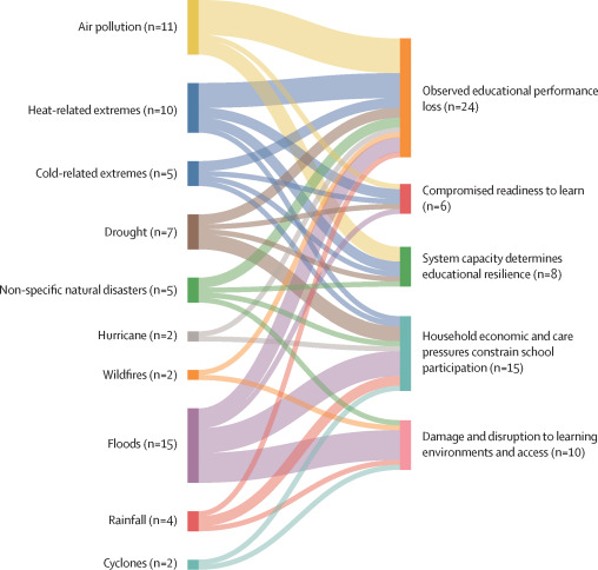
This raises an important question: could a trauma-responsive approach help us respond to climate-related disruption through a whole systems approach? Trauma-responsive practice does not assume that disruption is inherently traumatic. Instead, it asks how we can protect safety, predictability, trusted relationships, voice and agency, while recognising strengths, resilience and hope.
What questions are being asked, and why?
Currently, it is recognised that children and young people, and the people who care for them across children’s services and settings, are under-represented as collaborators in climate change research (e.g., Lawal, et al., 2025; Mohamed, et al., 2025; Watfern & Carnemolla, 2025). To find out what young people and the people around them consider the most important next research questions to ask, I currently have an international priority setting consultation open and a small exploratory study focusing on the impact of climate related disruption on schools underway. Through wider consultation with youth advisory groups, I am also exploring how future research in this area can meaningfully involve and empower young people in different roles, including as collaborators, advisors and advocates, while remaining flexible enough to reflect their changing lives, circumstances and preferences over time. This includes involving young people in designing the governance structures that shape how decisions are made, and co-developing safeguarding processes so that research about sensitive experiences and uncertain future challenges is conducted in ways that feel safe, respectful and appropriate. Young people, alongside those who care for them, can also help us decide what questions should be asked, how they should be asked, what support should be available, and how researchers should respond when concerns arise.
Although it is still early days, several themes are beginning to emerge. One is the importance of movement, outdoor space, thermal regulation, and familiar routines in helping some children manage and regulate themselves during the school day. One education professional described how extreme heat and wildfire smoke meant students could no longer go outside, even though outdoor activity formed part of the support some pupils received for emotional regulation:
“As a result many students had increased difficulty in emotional regulation, and disruption to routines which further dis-regulated them.”
“It’s really difficult to do anything when the classroom temperature is 30C.”
“Many people with ASD have difficulty with thermal regulation, which caused significant issues during heat waves.”
This illustrates how climate-related disruption may affect wellbeing not only through the environmental event itself, but by removing or disrupting the everyday strategies, spaces and routines that some children rely on to feel regulated and supported.
Another emerging theme is preparedness and the challenges facing schools, who often do not have suitable guidance to follow, which adds uncertainty and inconsistency across the system.
“A heat wave coincided with the wildfires during summer term … The school did not have permanent air conditioning in any classrooms.”
“Students on busses were sent home early to avoid the hottest part of the day, reducing the taught time for these students. Students who remained were not taught either and were entertained with movies.”
International contributors are also challenging us to think carefully about how we respond. One emphasised:
“Cultural humility – we need to see the world through the eyes of the children and families in these areas.”
Another highlighted the importance of:
“Ensuring youth voices are represented in this work, and not only youth who are the ‘superstar engagers’ in research practices.”
Climate-related disruption may affect children partly by disrupting the relationships, routines, environments and support systems around them. The task now is to understand those experiences before collaboratively co-designing responses to test and evaluate. As one advisor commented, we will need to think critically about the constructs that underpin our approach, and “How childism may prevent children voices from being heard.”
Going forward: What does this mean for practice, policy and research?
Clinical Practice
Climate-related disruption is not necessarily traumatic, and designing and deploying individualised mental health interventions is unlikely to be feasible or effective long-term. However, professionals can be alert to how extreme heat, flooding and other disruption affects the routines, relationships, environments and support that help children feel safe and well. A trauma-responsive perspective could shift the focus towards “What has been disrupted, what does this child need, and what might help restore safety, connection and agency in their world?” Further, by taking a trauma-responsive systems approach, we can consider what the needs and impact of climate disruption may be on the adults and systems in children’s lives, and how to help them prepare, cope, and recover over time.
Policy and Services
Schools, CAMHS and children’s services need practical plans for maintaining safe environments, trusted relationships, education and continuity of support during periods of disruption. Preparedness must also recognise that poverty, disability, existing adversity and unequal access to resources may leave some children and families with fewer opportunities to adapt. The systems around children also need the resources and capacity to prepare, enabling responses that protect safety, continuity and support rather than relying on reactive action once a crisis occurs.
Research and Design
For me, the priority is not simply to transfer existing trauma-responsive or crisis models into the climate context. We first need to understand children’s and families’ experiences, what already helps them adapt and recover, and how this differs between communities and cultures. The next step could be to co-design and test trauma-responsive approaches, asking what helps, for whom, in which circumstances and why.
Conclusions: Final thoughts
Climate-related disruption is not inherently traumatic, and trauma-responsive approaches should not pathologise understandable responses to difficult circumstances. There is still much we do not know, and much we can learn from communities around the world with longstanding experience of adapting to environmental and climate-related challenges.
By bringing together lived experience, local knowledge, international learning and research, we have an opportunity to develop tailored trauma-responsive approaches collaboratively and thoughtfully. As climate-related disruption becomes more frequent, these approaches could help children, families, schools and services build on their existing strengths, adapt to change and face uncertainty with greater safety, connection, coordination, agency and hope.
Please Take Part!
We would like to hear from you. Whether you can contribute an international perspective on children, climate and adversity, or work in education or children’s services in England or Wales, your experiences can help us understand the questions we should be asking and shape the next stages of this research.
International consultation
Climate-related disruption and children’s mental health: international consultation
We are inviting people internationally with professional, research or lived experience to help shape an emerging programme of research exploring how climate-related disruption affects children and young people, and what an equitable, youth-centred and trauma-responsive approach could offer.
https://www.qualtrics.manchester.ac.uk/jfe/form/SV_5tAdSXPLn2bEgoC
England and Wales survey
Climate-related disruption in schools and children’s services
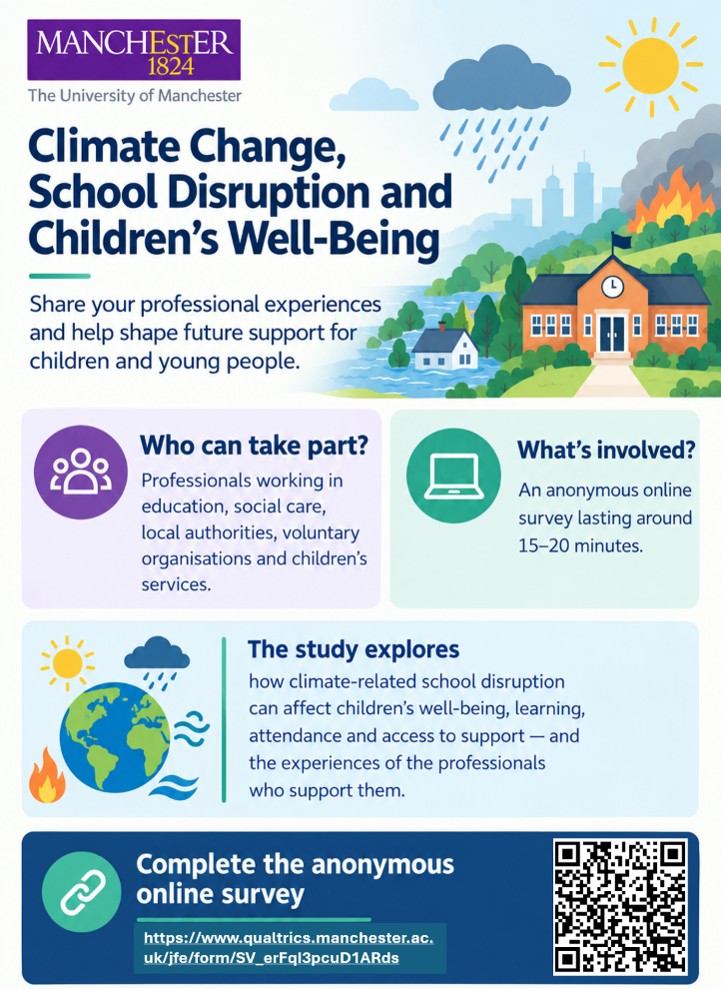
We are inviting education and children’s services professionals in England and Wales to share their experiences of how extreme heat, flooding, storms and other climate-related events are affecting children’s lives, learning and wellbeing, and what might help schools and services prepare, respond and recover.
https://www.qualtrics.manchester.ac.uk/jfe/form/SV_erFqI3pcuD1ARds
About the author

Dr Sarah Parry is a consultant clinical psychologist and academic whose research focuses on improving mental health services and support for children and young people. Her NHS-based research, funded by the NIHR, focuses on developing trauma-responsive approaches with children, young people, families and those who care for them, across CAMHS, crisis services and homes for care-experienced children, alongside addressing mental health inequalities. This research, together with her earlier work exploring how young people engage with climate change through social media, is now informing an emerging programme exploring trauma-responsive approaches to climate-related disruption across children’s services and settings.
Conflicts of interest
Conflicts of interest: Sarah Parry is a Chief Investigator of a NIHR funded study developing a trauma-responsive framework tailored for use in homes for cared for children and young people (NIHR206567) and trauma-responsive crisis protocol for out-of-hours crisis care (NIHR158509). Sarah is also leading some early-stage consultations and preliminary research to explore international priorities for trauma-responsive approaches to supporting children and young people being influenced by climate change, and the impact of the UK changing climate for schools.
References and links
- Ahdoot, S., Baum, C. R., Cataletto, M. B., Hogan, P., Wu, C. B., Bernstein, A., & Section on Minority Health, Equity, And Inclusion Garris Nia Heard MD, MSc, FAAP Brown Kimberly MD, FAAP Chomilo Nathan MD, FAAP Jones Nathaniel MD Rodriguez Patricia MD, FAAP Walker Valencia MD, FAAP Onyema-Melton Ngozi. (2024). Climate change and children’s health: building a healthy future for every child. Pediatrics, 153(3), e2023065505.
- Badger, J. R., Maile, A. J., Thompson, P., Bowes, L., Hutchings, J., & Broome, M. R. (2026). School Disruption and Classroom Climate on Teachers’ Burnout and Wellbeing. Psychology in the Schools.
- Lawal, M. O., Adeleke, G. F., Alatise, K. R., Kazeem, K. L., Lanre-Babalola, F. O., & Ibrahim, A. (2025). Building Resilience against Climate Change and the Need for Children Inclusion in Neighborhood Security Surveillance. Annals Constantin Brancusi U. Targu Jiu, Letters & Soc. Sci. Series, 303.
- Mohamed, M., Amin, S., Lever, E., Montini, A., Machida, K., Rajagopalan, S., … & Prost, A. (2025). Climate change and child wellbeing: a systematic evidence and gap map on impacts, mitigation, and adaptation. The Lancet Planetary Health, 9(4), e337-e346.
- Noor, J., Flanagan, E., Lacap, L. M., Farooq, M., Bezgrebelna, M., Fung, K., … & Kidd, S. A. (2026). The implications of climate change for the learning and development of children and youth living in poverty. The Lancet Public Health, 11(6), e408-e416.
- United Nations Children’s Fund. (2021). The climate crisis is a child rights crisis: Introducing the Children’s Climate Risk Index. UNICEF. ISBN: 978-92-806-5276-5
- Vergunst, F., & Berry, H. L. (2022). Climate change and children’s mental health: a developmental perspective. Clinical Psychological Science, 10(4), 767-785.
- Watfern, C., & Carnemolla, P. (2025). Inclusive climate action: A scoping review on the representation and inclusion of people with intellectual disability in climate change research. British Journal of Learning Disabilities, 53(3), 428-445.