
Primary to secondary school transitions have been widely recognized as a challenging process for students entering adolescence.1-3 During times of transition, students face a variety of challenges, including adapting to an unfamiliar environment, leaving close friends and adults behind, making new friends, and meeting new academic standards.4
For these reasons, adolescent school transitions can seriously impact a student’s social and emotional well-being. For instance, transitions could lead to increased anxiety and depression in early secondary school, difficulties connecting to others, a lack of a sense of belonging, and reduced motivation to achieve.5-9

Why are adolescent school transitions important?
School transitions are the process of changing from one school to another. For many teenagers, this process is symbolic – it marks the shift from childhood to adolescence, indicating a change in social status and how a teenager views themself.13
This rite of passage is an important milestone in a teenager’s life, which, when successful, can have many positive benefits. But if they encounter ongoing challenges, it could negatively impact their wellbeing.
As primary to secondary school transitions coincide with early adolescence, they can influence an important second window of development. Therefore, a teenager’s experiences during this key time can have long-lasting effects on their later development and well-being, and these effects can even extend into adulthood.10-12

How secondary school transition can impact wellbeing
A decline in a teenager’s wellbeing shouldn’t be solely put down to a school transition. There are many factors that could affect mental health as a student grows older.14 But if parents or teachers see a noticeable decline in a student’s wellbeing during school transition adjustment, this could lead to the question, “Is this decline due to adolescent school transition or age-related development?”
For the most part, evidence suggests there is a negative impact of school transitions on wellbeing, regardless of the age of the student transitioning. This implies that the transition itself is to blame, not necessarily the age of the teenager.15 Further, the impact of moving school may extend beyond the first year, indicating that transitioning is a prolonged adjustment process.15
Aside from wellbeing in general, adolescent school transition can affect a teenager’s cognitive engagement and perseverance. In other words, their willingness to put in effort and succeed academically. As high levels of perseverance and cognitive engagement during adolescence are associated with higher graduation rates, marital stability, and enhanced adult well-being, support for students experiencing school transition anxiety is essential.19

Factors that could affect school transition adjustment in adolescents
Studies have continuously highlighted a decline in mental health during adolescent school transition.15 These suggest that age-related development plays less of a role than the transition period itself, and outline that several factors may play a part, which are outlined below.
The gender of a student
Female students may show greater school transition anxiety in comparison to their male peers. While girls often report higher well-being than boys in primary school, they may show lower levels in secondary.16
This pattern might reflect the social and emotional challenges girls face during the transition period. For example, they may place higher importance on friendships, belonging, and social comparison – all of which can be disrupted during the move to secondary school.8
The environment a teenager comes from
Students who come from more rural environments, which are usually characterized by smaller class sizes and closer friendships, may have a smoother transition if they move schools with someone they know.17 This is likely because they experience a greater sense of school belonging during transition.
However, this effect may only be seen up to a certain point, for example, the third year after transition. At this point, students from more urban areas may start to engage more with the academic and social demands of their new environment.15
It’s difficult to say why rural students’ wellbeing drops at this point, but rural communities differ largely in regard to housing stability, access to healthcare, and educational attainment. Each of these factors could play a role in the long-term wellbeing of a student.
Additionally, students who come from non-English speaking backgrounds and those whose parents have higher levels of education may report lower school transition anxiety.15
The school a student transitions to
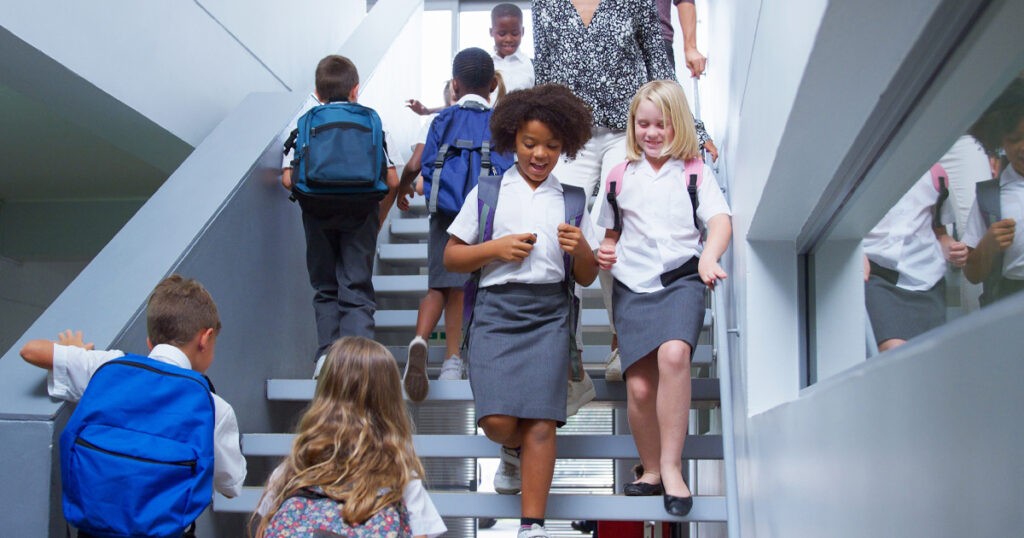
During adolescent school transition, students enter an entirely new environment and have to rebuild connections with peers, teachers, and other adults during a time of stress.
Studies show that the new school environment plays a key role in a student’s willingness to succeed during the primary to secondary school transition. The overall nature of the new environment, including the relationships with teachers and peers, can lead to better engagement and overall mental health.18
Drop-downs in support during adolescent school transition
It’s not just the first year of a transition that can impact a teenager’s wellbeing. As previously mentioned, the effects can persist into the second year – or even newly emerge after a period of adjustment. Students who appeared to adapt successfully in the first year may face renewed difficulties as academic demands increase, class structures evolve, and peer relationships shift.18
One possible reason for this is how there may be drop-downs in the levels of support offered by schools and teachers after the first year. When students are seen as already having adjusted, there may not be as much of a drive to help them continue settling in.18
Future directions for improving secondary school transition wellbeing
Adolescent school transitions can have a significant and sustained impact on students’ wellbeing. As these impacts have been seen to extend into adulthood, more research may be needed to fully examine the effects of moving school on teenagers’ future outcomes and mental health.
Cognitive engagement and perseverance were two of the areas showing most decline after transition. Therefore, schools, healthcare professionals, and service providers could consider incorporating transition support programmes that teach effective learning strategies. These could help mitigate any potential long-term outcomes for students’ future wellbeing.
Secondary school transition wellbeing support should also extend beyond the first year, as the negative effects of moving schools can persist. And finally, as female students and those living in remote areas could be disproportionately affected, future transition support programs should place greater emphasis on these vulnerable groups. This could help them develop the transition resilience adolescents need.
For professionals wishing to learn more do please take a look at my open access JCPP paper Well-being decline during adolescence: school transition as a predominant driver beyond age progression. Authors; Mi Zhou, Carol Maher, Sally Brinkman, Juliette Cools, Dorothea Dumuid. First published: 21 April 2026.
References
- Hopwood, B., Hay, I., & Dyment, J. (2016). The transition from primary to secondary school: Teachers’ perspectives. The Australian Educational Researcher, 43, 289–307.
- Kaur, T., McLoughlin, E., & Grimes, P. (2022). Mathematics and science across the transition from primary to secondary school: A systematic literature review. International Journal of STEM Education, 9, 13.
- Zeedyk, M.S., Gallacher, J., Henderson, M., Hope, G., Husband, B., & Lindsay, K. (2003). Negotiating the transition from primary to secondary school: Perceptions of pupils, parents and teachers. School Psychology International, 24, 67–79.
- Symonds, J. (2015). Understanding school transition: What happens to children and how to help them. London: Routledge. https://doi.org/10.4324/9781315714387
- Hannah, E.F., & Topping, K.J. (2012). Anxiety levels in students with autism spectrum disorder making the transition from primary to secondary school. Education and Training in Autism and Developmental Disabilities, 47, 198–209.
- Waters, S.K., Lester, L., Wenden, E., & Cross, D. (2012). A theoretically grounded exploration of the social and emotional outcomes of transition to secondary school. Journal of Psychologists and Counsellors in Schools, 22, 190–205.
- Lofgran, B.B., Smith, L.K., & Whiting, E.F. (2015). Science self-efficacy and school transitions: Elementary school to middle school, middle school to high school. School Science and Mathematics, 115, 366–376.
- van Rens, M., Haelermans, C., Groot, W., & Maassen van den Brink, H. (2018). Facilitating a successful transition to secondary school: (how) does it work? A systematic literature review. Adolescent Research Review, 3, 43–56.
- Witherspoon, D., & Ennett, S. (2011). Stability and change in rural youths’ educational outcomes through the middle and high school years. Journal of Youth and Adolescence, 40, 1077–1090.
- Benner, A.D., & Mistry, R.S. (2020). Child development during the COVID-19 pandemic through a life course theory lens. Child Development Perspectives, 14, 236–243.
- Elder, G.H., Jr. (1998). The life course as developmental theory. Child Development, 69, 1–12.
- Eccles, J.S., Lord, S., & Buchanan, C.M. (2018). School transitions in early adolescence: What are we doing to our young people? In Transitions through adolescence (pp. 251–284). New York, NY: Psychology Press. https://doi.org/10.4324/9781315789286
- Symonds, J. E., & Barlow, W. (2024). School transitions. In Encyclopedia of Adolescence (2nd ed.). Elsevier. https://www.sciencedirect.com/topics/psychology/school-transitions
- Blanchflower, D.G., & Oswald, A.J. (2008). Is well-being U-shaped over the life cycle? Social Science & Medicine, 66, 1733–1749.
- Zhou, M., Maher, C., Brinkman, S., Cools, J., & Dumuid, D. Well-being decline during adolescence: School transition as a predominant driver beyond age progression. Journal of Child Psychology and Psychiatry. https://doi.org/10.1111/jcpp.70154
- Konu, A.I., & Lintonen, T. (2006). School well-being in grades 4-12. Health Education Research, 21, 633–642.
- Kvalsund, R. (2000). The transition from primary to secondary level in smaller and larger rural schools in Norway: Comparing differences in context and social meaning. International Journal of Educational Research, 33, 401–423.
- Jindal-Snape, D., Hannah, E.F.S., Cantali, D., Barlow, W., & MacGillivray, S. (2020). Systematic literature review of primary–secondary transitions: International research. Review of Education, 8, 526–566.
- Eskreis-Winkler, L., Duckworth, A.L., Shulman, E.P., & Beal, S. (2014). The grit effect: Predicting retention in the military, the workplace, school and marriage. Frontiers in Psychology, 5, 36.