Slides and recordings are for delegates only
Session 3
Slides – Associate Professor Joni Williams Splett – Targeted and Intensive Support – Tiers 2 & 3
Session 2
Slides Professor Brian P. Daly – Implementing universal intervention strategies and Multi-systems of Support in Schools: What works and for whom?
Session 1
Slides Professor Mark D. Weist – Advancing Effective School Mental Health Practices (22/01/26)
This short course, Mental Health in Schools: Practical Strategies for a Stepped, Collaborative Approach, consists of three live online sessions delivered by Professor Mark D. Weist, Professor Brian P. Daly, and Associate Professor Joni Williams Splett.
The sessions provide a concise introduction to school mental health, highlighting the value of comprehensive multi-tiered systems of support (MTSS) and exploring strategies at universal, targeted, and intensive levels of intervention. Participants will learn about the core processes that underpin effective programming, including teamwork, data-based decision making, evidence-based practices, and progress monitoring.
The course also emphasises the role of relationships between school staff, community partners, students, and families, and the importance of student and family voice and leadership. Examples of school mental health communities of practice will be discussed, and attendees will be connected to relevant resources, networks, and conferences to continue their learning beyond the sessions.
Overall learning outcomes include; understanding the value of school mental health to education, mental health and other youth-serving systems,understanding key strategies to assure SMH is effective in promoting positive school and student outcomes, presenting a range of relevant resources and networks to participants.
Ebook
About the day
Professor Mark D. Weist – Advancing Effective School Mental Health Practices (22/01/26)
This session introduces the foundations of effective school mental health practices. Professor Mark D. Weist will provide a brief history of the field and describe the advantages of school mental health (SMH). The session highlights the Multi-Tiered System of Support (MTSS) as the central framework and reviews its core processes, including teamwork, data-based decision making, use of evidence-based practices, and progress monitoring. Attention will also be given to the importance of relationships within schools, the role of family and youth voice and leadership, and the value of communities of practice. Participants will also be introduced to relevant networks, conferences, and resources to support their ongoing engagement in the field.
Learning outcomes
1. Describe the advantages of school mental health and the role of MTSS as a guiding framework.
2. Identify key processes that contribute to effective school mental health programming, including teams, data-based decision making, evidence-based practices, and monitoring.
3. Recognise the importance of relationships, family and youth voice, and communities of practice in advancing school mental health, and be aware of relevant resources and networks.
Professor Brian P. Daly – Implementing universal intervention strategies and Multi-systems of Support in Schools: What works and for whom? (29/01/26)
Research consistently demonstrates the positive role of social and emotional competencies in supporting successful youth outcomes, including academic achievement. One method of promoting children’s social and emotional functioning is the implementation of universal intervention strategies in schools. Traditionally, however, behavioral health services in the school setting are offered only to youth referred to special education, with little focus on prevention or early intervention for the general school population.
One of the primary advantages of providing school-based prevention programming includes increased accessibility for disadvantaged and vulnerable populations, better opportunities to engage parents and teachers in fostering the mental health of children, and significantly enhanced capacity for broad mental health promotion as well as the potential for cost-savings and long-term benefits. Therefore, the delivery of evidence-based universal programming in schools by mental health personnel and educators is needed to promote positive academic and mental health outcomes while also preventing the progression to more serious negative outcomes.
Comprehensive school mental health (SMH) systems, involving a multi-tiered system of support and services (MTSS) in schools, are increasingly recognized as a vital component of the child and adolescent mental health system. Universal intervention strategies, delivered through MTSS and in partnership with meaningful engagement with diverse stakeholders emphasizing family voice, demonstrate compelling results—this is the focus of this presentation.
Learning outcomes
1. To understand how school environments shape mental health and identify key protective factors
2. To understand the components of Multi-Tiered Systems of Support (MTSS)
3. To learn about evidence-based universal interventions to support all students (Tier 1)
4. To understand how families can be involved
Associate Professor Joni Williams Splett – Targeted and Intensive Support – Tiers 2 & 3 (05/02/26)
This presentation provides a comprehensive overview of effective strategies to support students with emerging or intensive social, emotional, and behavioral needs. Participants learn how to identify students who benefit from additional support beyond universal Tier 1 strategies, using data-informed practices and early warning signs. The session explores evidence-based Tier 2 and Tier 3 interventions, with a focus on selecting and implementing targeted and individualized supports that address students’ specific needs.
Emphasis is placed on fostering collaboration among educators, school mental health professionals, and community-based providers to create a cohesive network of care. Additionally, participants gain tools for meaningfully involving families in the intervention process, recognizing their vital role in supporting student growth and resilience. By the end of the session, attendees are equipped with practical strategies to enhance multi-tiered systems of support (MTSS) and promote student well-being through shared responsibility and coordinated action.
Learning outcomes
1. To understand how to identify students who may need additional social, emotional and behavioral supports
2. To examine strategies for Tier 2 and Tier 3 interventions
3. To learn how to coordinate support between educators, school mental health staff, and other community professionals
4. To involve families in Tier 2 and 3 intervention supports
Speakers
Mark D. Weist received a Ph.D. in clinical psychology from Virginia Tech, and is a Professor at the University of South Carolina. In 1995, with other leaders from the University of Maryland, he established the National Center for School Mental Health, now in its 30th year (see www.schoolmentalhealth.org). He has published and presented widely in areas of mental health-education system partnerships, school behavioral health (SBH), trauma, evidence-based practice, and advancing policies that support children and youth at local, state, regional, national, and international levels of scale. He currently leads the Southeastern School Behavioral Health Community, and co-chairs the School Mental Health International Leadership Exchange.
Brian P. Daly, Ph.D. is the Department Head for the Department of Psychological and Brain Sciences at Drexel University. Dr. Daly received an undergraduate degree in psychology from Boston College and a doctorate in counseling psychology from Loyola University in Chicago. He is a licensed psychologist specializing in child and adolescent psychology. Dr. Daly’s areas of interest in research include prevention and resiliency in urban youth; school mental health promotion; evidence-based psychosocial interventions for youth; leadership in schools; and global leadership in school mental health. His research has been funded by federal, foundational, and corporate agencies. Dr. Daly and his lab members in the Pediatric and Child Adolescent Psychology lab (PCAP) make a difference by engaging in research that supports those youth most in need but least likely to receive evidence-based behavioral health services. Dr. Daly and his team study and provide services to underserved children in the community setting where they spend most of their waking hours: the classroom. Dr. Daly and his team are committed to making a difference in the lives of youth by designing and delivering interventions that enhance social skills and behavioral competencies to promote positive developmental outcomes and healthy adjustment. Dr. Daly is the President of the Council of Graduate Departments of Psychology (COGDOP), a leadership society constituted of Chairs and Heads of Departments of Psychology from national and international universities that is focused on issues related to the field of psychology and the needs of graduate education.
Joni Williams Splett, Ph.D., is an Associate Professor in the School Psychology program and a Licensed Psychologist. She studies systems-level strategies to promote youth mental health in schools and reduce health disparities, including teaming, universal screening, and the Interconnected Systems Framework. Dr. Splett’s research has been funded by several federal agencies, foundations, and other community partners including the U.S. Departments of Education and Justice, National Institutes of Health, and the Patient-Centered Outcomes Research Institute.
Blog
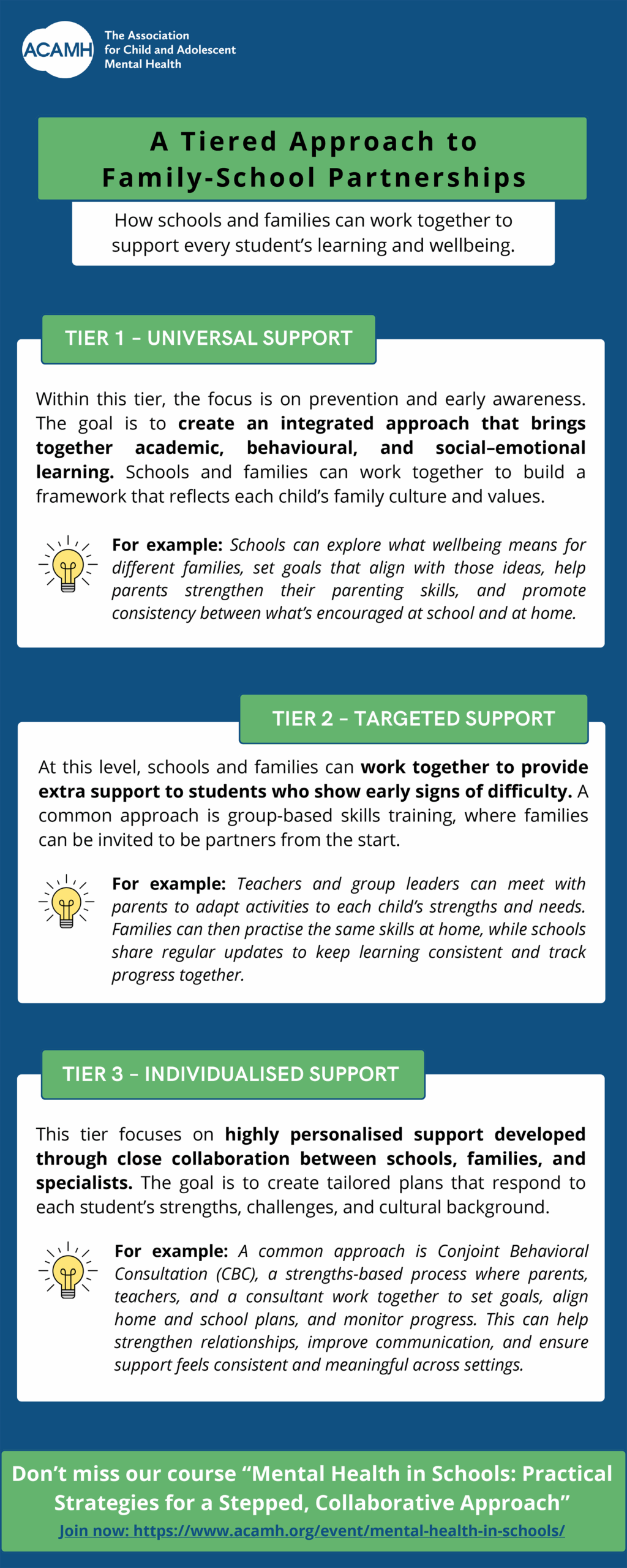
Promoting Mental Health in Schools: Evidence-Based Strategies for a Stepped, Collaborative Approach – Recent research has highlighted the advantages of comprehensive school mental health (SMH) systems, particularly those organised around Multi-Tiered Systems of Support (MTSS). MTSS provides a coherent structure integrating prevention, early intervention and intensive support to meet diverse student needs (Barrett et al., 2018) acknowledging the interdependence of academic outcomes, mental health and social-emotional development.
Infographic